
£20 Minimum Deposit Casinos in the UK: What to Check
 Available in GB
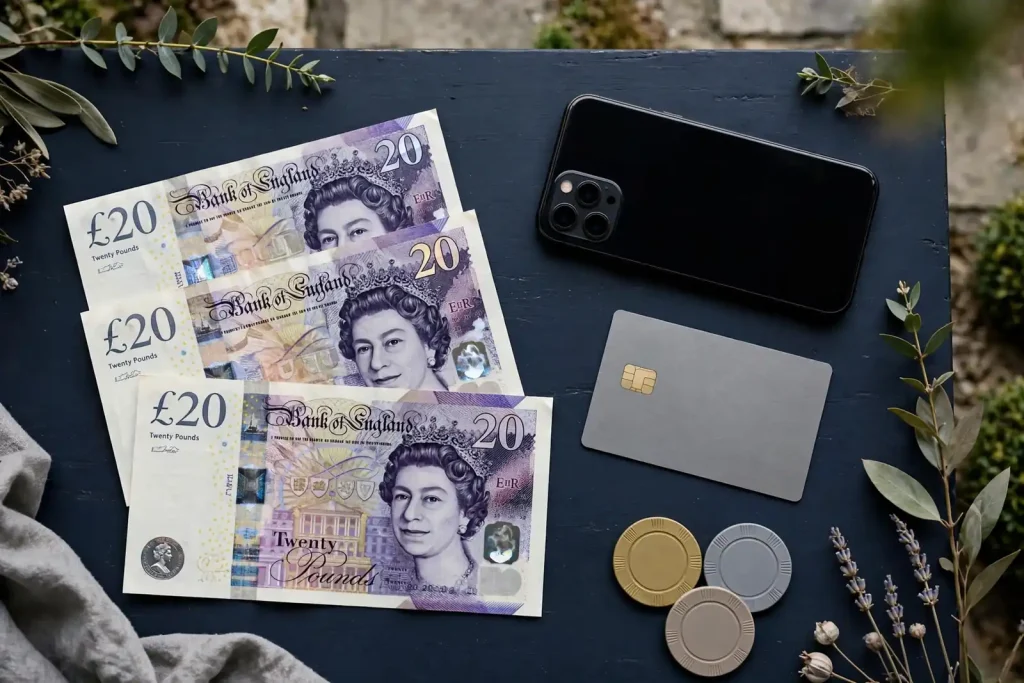
A practical look at deposit thresholds, bonus wagering rules, payment methods and cash-outs before choosing a UK casino.
What a £20 Minimum Actually Tells You
A £20 minimum deposit tells you where one casino has set its cashier threshold. It does not describe the whole UK market, and it does not mean that £20 is the smallest amount you can put into an online casino account elsewhere. Some UK casinos accept deposits from £1, so a £20 starting point sits well above the lowest end of the range.
I used to treat the number beside the deposit button as if it were a general rule. It isn’t. It is an operator’s rule for that account, and it can make a site unsuitable if you want to start with less. The useful question is not whether £20 is “low” or “high” in isolation; it is whether that minimum matches the amount you have decided you are comfortable risking.
That distinction matters on mobile, too. A casino website or app may show the same cashier minimum whichever screen you use. Finding a mobile casino with a £20 minimum deposit is therefore a question about the operator’s stated threshold, not a separate category where the amount automatically means something different. Check the cashier information before you create a plan around a figure you saw elsewhere.
If you’re looking for a UK casino with a £20 minimum deposit, check the deposit terms before choosing. The details available here let you assess one practical point: stated payout speed.
1. Zombillion
Payout speed: 1-3 business days Zombillion lists a payout speed of 1–3 business days. Check its deposit terms to confirm whether the £20 minimum suits you.
2. NightLuck
Payout speed: 1-3 business days NightLuck lists a payout speed of 1–3 business days. Check its deposit terms to confirm whether the £20 minimum suits you.
3. Chanze
Payout speed: 1-3 business days Chanze lists a payout speed of 1–3 business days. Check its deposit terms to confirm whether the £20 minimum suits you.
4. WinBeast
Payout speed: 1-3 business days WinBeast lists a payout speed of 1–3 business days. Check its deposit terms to confirm whether the £20 minimum suits you.
5. Amunbet
Payout speed: 1-3 business days Amunbet lists a payout speed of 1–3 business days. Check its deposit terms to confirm whether the £20 minimum suits you.
6. BeOnBet
Payout speed: 1-3 business days BeOnBet lists a payout speed of 1–3 business days. Check its deposit terms to confirm whether the £20 minimum suits you.
7. EvoSpin
Payout speed: 1-3 business days EvoSpin lists a payout speed of 1–3 business days. Check its deposit terms to confirm whether the £20 minimum suits you.
8. Dieselwin
Payout speed: 1-3 business days Dieselwin lists a payout speed of 1–3 business days. Check its deposit terms to confirm whether the £20 minimum suits you.
9. NightWin
Payout speed: 1-3 business days NightWin lists a payout speed of 1–3 business days. Check its deposit terms to confirm whether the £20 minimum suits you.
10. Revery Play
Payout speed: 1-3 business days Revery Play lists a payout speed of 1–3 business days. Check its deposit terms to confirm whether the £20 minimum suits you.
The range is wider than the headline
At one end, some casinos allow a deposit as small as £1. At the other, an operator may require £20 to get money into the account. Those are meaningfully different starting points, even though both can be described as minimum-deposit casinos. If you want to keep an initial deposit modest, a £20 threshold may rule out a site before you have considered anything else.
A £20 minimum is not, by itself, evidence that a casino is better, worse, more generous or more trustworthy. It tells you only what amount the cashier permits as a starting deposit under the terms shown to you. Nor should you assume that a lower threshold makes a casino automatically more suitable. The amount is one practical condition, not a quality rating.
I have made the mistake of focusing on the number and ignoring the decision behind it: how much I was prepared to lose. Before your first deposit, set a financial limit you can afford, then treat the cashier minimum as a constraint rather than a reason to increase that limit. If the site asks for more than you are willing to put in, walking away is a perfectly sensible answer.
Direct banking can have a different threshold
Direct banking does not produce one fixed minimum across UK casinos. A specialist review describes £10 as the typical minimum among casinos accepting direct banking, while also recording operators that set it at £5 or £20. That makes a £20 threshold plausible for this route, but not universal. The cashier at the specific casino is what matters.
£2 Minimum Deposit Casinos in the UK: What to Check
This is a useful reminder not to assume that a number from one comparison applies everywhere. A site might accept a smaller deposit through one route and set a higher minimum for direct banking, or display a threshold that differs from the one you expected. The payment choice and the casino’s rules both matter; a general figure cannot settle what your own account will be allowed to deposit.
If you are comparing two sites, look for the minimum shown for the route you actually intend to use. Don’t rely on an old comment, a headline, or a figure copied from a different casino. A stated £20 minimum should be read literally: if that is the cashier’s minimum for your chosen route, a smaller amount will not meet it.
There is no need to force the comparison into a ranking. A £20 minimum deposit online casino may suit someone who has already decided that £20 is their limit. Someone who wants to start below that amount can look for a casino that accepts less, while remembering that its own rules still apply. Neither choice makes sense unless the amount fits your budget.
So, when you see “£20 minimum”, read it as a boundary on making a deposit at that operator—not as a market standard or a recommendation to spend that much. The UK range includes casinos accepting less, and direct-banking thresholds vary between operators. Check the current cashier terms, choose your limit first, and don’t let the minimum choose your budget for you.
A £20 minimum deposit is an operator’s specific rule for that account and not a general UK market standard, as some casinos accept deposits from as little as £1.
That’s the baseline.
Putting £20 In: The Deposit and Cash-Out Reality
A £20 deposit is not the same thing as £20 you can necessarily take straight back out. Once the money reaches your casino balance, it may be available to play with, but the operator’s rules still determine when and how a withdrawal can be requested. I learned to separate those two ideas after treating the cashier’s deposit figure as if it described the whole journey. It doesn’t.
The first thing I check now is what the balance actually represents. A displayed total can include money that is still subject to conditions, while the amount available to withdraw may be different. That distinction matters even if you have not claimed an offer: the cashier’s rules, account status and any outstanding requirements can affect what you can request. I don’t assume a number on the screen is automatically cash-ready.
Then there is the withdrawal minimum. A specialist casino review I read reported minimum cash-out thresholds of £10 to £20 at many UK casinos. That is a reported range, not a rule that applies everywhere, and it can change. Still, it shows why a £20 deposit needs to be considered alongside the withdrawal terms. If the minimum cash-out is £20, a balance below that point may not be withdrawable yet. If the threshold is lower, the position is different. The operator’s own cashier information is what you need to rely on.
£3 Minimum Deposit Casinos in the UK: What to Know
That can feel counterintuitive. You put money in successfully, so it is natural to think the same amount can be sent back whenever you choose. But a minimum deposit and a minimum withdrawal are separate settings. The first tells you what the account will accept; the second tells you the balance level at which a cash-out request can be made. Neither tells the whole story alone.
I also avoid thinking of a deposit as a sealed pot that stays untouched until I decide what to do with it. Once it is in the account, you may use it to play, and the remaining balance can change. If you want to withdraw, the amount left in your account is what matters, not simply what you originally paid in. That sounds obvious written down. In the moment, it is easy to mentally count the original deposit as still yours in full.
So before sending £20, I look for the withdrawal section as well as the deposit line. I want to know whether there is a stated minimum, whether the cashier explains what happens when a request is below it, and whether the balance has to be available rather than merely visible. If the wording is unclear, I would rather pause than assume the operator will make an exception.
There is another small but useful habit: keep the deposit and withdrawal rules open while you decide, rather than relying on memory from a promotional page or an old review. Casino terms can be updated, and details presented in one place may not be the full cashier policy. A clear answer should tell you what amount can be requested and what conditions have to be met first. If you cannot find that answer, the uncertainty is part of the decision.
Do
- Check the minimum withdrawal threshold before depositing
- Verify if your balance must be available rather than just visible
- Keep the deposit and withdrawal rules open during your decision
Don’t
- Assume the deposit amount is the same as the cash-out minimum
- Treat the deposit figure as a description of the whole journey
- Rely on memory from old reviews or promotional pages
I used to focus on getting money into the account and treat getting it back as a later problem. That order is backwards. Before depositing, decide what you would do if the balance were ready to leave, then check whether the casino’s minimum would let you request that amount. It doesn’t guarantee a particular outcome; it simply keeps you from discovering the basic rule after the money is already there.
A £20 minimum deposit casino in the UK may make the initial step feel straightforward, but the cashier minimum is only one part of the money journey. The useful question is not just whether the site accepts your £20. It is whether you understand what happens to the balance afterwards, including the point at which a withdrawal request becomes possible.
I’m not suggesting you need to map every hypothetical before playing. I am saying the exit rule is worth reading while the choice is still yours. Deposit limits can look reassuringly simple. Cash-out terms are where that simplicity often ends. Check both, and don’t mistake “accepted” for “available to withdraw.”
A Bigger Deposit Does Not Make a Welcome Offer Better
A £20 cashier minimum tells you what you must put in to fund an account; it does not tell you what you will get in return. I used to treat a larger first deposit as a way to make a welcome offer more worthwhile. That was backwards. The amount only matters to the promotion if the offer’s terms say it does.
£4 Minimum Deposit Casinos in the UK: What to Check
Before opting in, look for the qualifying deposit, whether you must select the offer before depositing, and which deposit counts as your first one. Those details decide eligibility. A casino can accept a deposit at its cashier minimum while setting a higher threshold for a promotion. One specialist review describes offers that require a £10 qualifying deposit even where the platform accepts £5. So a lower cashier minimum does not guarantee access to the headline deal.
There is another wrinkle: a deposit can be accepted without being eligible for a welcome promotion at all. A specialist review reports that some casinos exclude their lowest deposit bracket from welcome offers. It also describes welcome offers with qualifying deposits in the £5-to-£10 range; on that account, paying £1 may fund the account but not trigger a deal. Treat those figures as details to verify against the current terms, not a promise that every casino uses the same thresholds.
That distinction matters when you are comparing a £20 minimum deposit casino with a site that accepts less. If the offer requires a qualifying deposit of £10, putting in £20 does not automatically make the offer twice as good. It may simply mean you have deposited more than the amount needed to qualify. If the promotion excludes your chosen deposit bracket, a larger payment might change eligibility only when it crosses the stated threshold. Read the offer, not the banner.
“Best” is often advertising shorthand for “the offer we want you to notice”. I would compare the exact qualifying conditions rather than trust a label or a large headline figure. Check whether the promotion is available to new customers, whether it must be claimed, and what deposit amount it recognises. If the terms are unclear, do not assume the cashier’s acceptance means the bonus will follow.
Attention: A casino may accept a £20 deposit at its cashier while setting a higher threshold for a welcome promotion, or even exclude the lowest deposit bracket from offers entirely.
The same applies to searches for a new casino or a no-deposit bonus. A site being new to you does not mean its promotion has looser conditions, and a no-deposit offer is a separate kind of promotion from one that requires a qualifying payment. Check the terms attached to that specific offer instead of assuming a £20 deposit will unlock it. New to me is not the same as a better deal.
I have also learned not to deposit extra just to chase an offer I have not checked. Decide what you can afford to lose first, set a financial limit before your first deposit, then see whether the promotion fits that limit. If it does not, skipping it is a perfectly sensible choice. The deposit is your money; promotional wording does not make it less so.
For a fair comparison, separate three things: the cashier minimum, the promotion’s qualifying amount, and whether you actually want the offer. A £20 deposit can meet a threshold, exceed it, or still fail the terms. Those are different outcomes, even if the promotional page makes them look like one. Read the conditions before paying. No guesswork.
Not on Gamstop? Check What You’re Choosing
If you’re looking at a £20 minimum deposit casino that isn’t on GamStop, pause over what “not on GamStop” means for you. If you have self-excluded because gambling was getting difficult to control, finding another place to play may undo the barrier you put in place. I know the temptation to treat a new account as a fresh start. It isn’t necessarily one.
£5 Minimum Deposit Casinos in the UK: What to Know
I wouldn’t read “not on GamStop” as a safety label, or as proof that a casino is suitable for someone who has chosen to self-exclude. It only tells you something about whether that site is part of the service. It doesn’t answer the more important question: whether depositing is a good idea for you right now.
There’s a legal distinction worth keeping clear, too. A casino taking real-money bets from people in Great Britain must hold a UK Gambling Commission licence. An offshore site without that licence sits outside the UK regulatory system; the fact that you can reach it does not make it a UK-licensed casino. I wouldn’t treat access as reassurance.
Be wary of payment workarounds
Some people look for mobile casinos that let them pay by SMS, especially when searching for a particular deposit amount. But a text-message payment isn’t a way around the UK rules on gambling deposits. The permitted funding routes are debit cards, e-wallets funded by debit, and bank accounts. Credit cards cannot be used to fund gambling.
That distinction matters even if a payment screen makes a method look simple. Don’t assume a charge added to a phone bill is an acceptable way to fund a UK-licensed gambling account. If a site is offering something that seems to dodge the normal safeguards, I’d step back rather than enter payment details.
In Britain, you must be at least 18 to gamble online. For a UK-licensed operator, age checks are part of the process before you can deposit. New customers must also be prompted to set a financial limit before their first deposit, with account controls available afterwards. These checks aren’t paperwork to click through blindly; they are chances to stop and decide what you can afford to lose.
Risk of Relapse
If you are searching for a casino not on GamStop to bypass an active self-exclusion, this may undo the barriers you put in place for your own protection.
If you’re searching for an alternative because you want to get around an active self-exclusion, I’d take that as a reason not to deposit, rather than a cue to find a different cashier. Talk to someone you trust, or contact a gambling-support service. No offer or payment route changes the reason you set the block in the first place.
How Far £20 Goes on the Slots
A £20 balance can look substantial beside a small spin size, but the arithmetic only tells part of the story. Many slots let you stake between 10p and 20p per spin. If you spent the full balance at 10p each time, that would cover 200 spins; at 20p, it would cover 100. Those are simple totals before any wins or losses change the balance.
I used to read a low stake as a promise of a long session. It isn’t. A run of losing spins can shrink the balance quickly, while a win may give you more to play with or make you decide to cash out. The game’s results determine how far the money lasts, not the number of spins suggested by dividing your deposit by your chosen stake.
That distinction matters when you’re comparing slots available at a casino with a £20 cashier minimum. The deposit amount does not set your stake, and it does not guarantee that every game accepts the same bet size. Check the selected game’s controls before you start, rather than assuming the smallest stake shown on one slot applies across the whole lobby.
No-Minimum-Deposit Casinos in the UK: What to Check
I’d also decide what I’m prepared to lose before opening a game. A small stake can make each spin feel less consequential, which is exactly how it can tempt you to keep going. Setting a spending limit before depositing gives the session a boundary; chasing a longer run by adding more money changes the decision, not the odds.
Keep your stake steady if your aim is to see how a balance behaves. Increasing it after a losing streak means each following spin uses more of what remains, so the theoretical spin count falls. Dropping it can preserve the balance for more spins, but it cannot make a losing game turn around. No magic setting.
A useful way to think about a £20 deposit is as a starting balance, not a session-length estimate. At 10p per spin, the calculation gives 200 spins only if the balance is reduced by exactly 10p each time and nothing is returned. At 20p, the same assumption gives 100. Real play can diverge from either figure immediately.
So choose a stake you can tolerate losing repeatedly, and stop when you reach the limit you set. The small numbers can make the session feel harmless; the total still comes out of your own money.
Bonus Terms Have Changed: Read the Wagering Rule
A bonus can look straightforward until you open its terms. I used to focus on the headline and treat the wagering line as small print. That was backwards. The deposit is money you add to your account; wagering is a condition attached to bonus funds or winnings from them. They are not the same thing.
UKGC Wagering Cap
As of 19 January 2026, the UK Gambling Commission limits gambling incentives so that they cannot require wagering of more than ten times the bonus funds.
The rules changed on 19 January 2026. From that date, the UK Gambling Commission’s limit means a gambling incentive cannot require wagering of more than ten times the bonus funds. If an offer’s terms still show a higher requirement, don’t treat that as an ordinary condition to accept without question.
That cap does not turn bonus money into cash you can withdraw straight away. The promotion can still have game restrictions, a maximum withdrawal cap, and other conditions. Those bonus rules relate to the bonus amount, not to whether you deposited by card, e-wallet or direct banking. Changing payment route does not rewrite the wagering terms.
Read beyond the headline
I now look for the full promotion terms before opting in. Check what amount the wagering calculation applies to, which games count, and whether a cap limits what you can withdraw from the promotion. A phrase like “easy bonus” tells you none of that.
Bonus funds also have an expiry period: the operator must set it within the permitted window of 7 to 30 days. Make sure you know when that clock starts and what happens if you do not meet the conditions in time. While wagering bonus funds, you must not stake more than £5 on a spin. Those limits matter even if the deposit itself was accepted without fuss.
A “no-deposit bonus” is a label, not a promise that there are no conditions. If you see one, read the terms for the wagering requirement and withdrawal restrictions before counting any winnings as available cash. The same goes for a casino bonus linked to a £20 deposit: the amount you paid in does not tell you how the bonus is calculated or what can be withdrawn.
Online casinos with no sister sites in the UK
I have learned not to judge an offer by the number on its banner. Find the rules, read them before opting in, and decide whether the conditions are worth dealing with. If they are unclear, leave it. Small print still counts.
Cards, Banking and E-Wallets: The £20 Payment Route
A £20 cashier minimum does not necessarily mean every way of paying has its own £20 rule. At a given UK casino, the minimum is generally shared across the payment options, but there are exceptions: a casino may ask for a higher amount when you choose direct banking than it does for a debit card or e-wallet. So if you have £20 ready, check the amount shown after selecting your preferred route, not just the headline minimum on a page.
Visa and Mastercard debit cards are accepted at almost all UK casinos and can support small deposits. That makes a debit card a straightforward option when the cashier minimum is the main thing you are checking. Still, accepted does not mean identical in every detail: the operator’s cashier will show which methods are available to you and the minimum attached to each one.
Direct banking can suit someone who prefers paying from a bank account rather than entering card details. But this is where a higher threshold may apply. If the cashier displays a minimum above the amount you intended to deposit, switching to a card or eligible e-wallet may show a different minimum. Check before confirming; don’t assume the first option represents every route.
Payment Methods
In the UK, gambling deposits must be funded via debit cards, e-wallets funded by debit, or bank accounts; credit cards are prohibited.
E-wallets can be another way to move money into a gambling account, but the funding source matters. For UK gambling, an e-wallet used for a deposit must be funded by debit, not credit. A wallet is not a workaround for the credit-card restriction.
That restriction dates back to the UK Gambling Commission’s 2020 ban on credit-card gambling. In practical terms, casino deposits must come from a debit card, an e-wallet funded by debit, or a bank account. If a payment screen appears to offer credit as a funding route, stop and check rather than treating it as an acceptable alternative.
I’ve learned not to choose a payment method just because it is familiar. A £20 deposit is still £20, but the cashier may present different minimums depending on the route. Read the amount beside the method you actually intend to use, and make sure you are comfortable with the source of the funds before proceeding.
Before a first deposit, a UK-licensed operator must verify your age and prompt you to set a financial limit. Take that pause seriously. Pick a limit that fits your own budget, then select a permitted payment route only if the displayed minimum works for you. No need to force the payment through.
Checking a Casino’s Credentials Before You Deposit
A familiar name and a polished cashier do not prove that a casino is trustworthy. I’ve learned to treat “trusted” as a claim to check, not a label to take on faith. For a site serving players in Great Britain, the first check is whether the operator holds a current UK Gambling Commission licence. Remote operators selling into the British market need the relevant licence, even if the company is based elsewhere.
Look up the operator on the Commission’s register and make sure the details match the casino you intend to use. A similar name or a link to a regulator’s website is not enough on its own. If the operator behind the site is unclear, or the licence details do not line up, I would stop there rather than enter payment information.
Very low cashier minimums can be useful context, but they are not a safety certificate. A specialist casino review reported verifying six UKGC-licensed casinos that accepted genuine £1 deposits, and named NetBet as the only UKGC-listed casino on its list with that cashier minimum. Treat that as a time-sensitive snapshot, not a permanent directory. The point is to verify the current operator and its licence yourself, rather than assuming that a low threshold—or a review’s wording—settles the question.
Before depositing, check that the casino verifies your age: UK players must be at least 18, and operators must check age before allowing deposits. A UK-licensed site should also prompt new customers to set a financial limit before the first deposit and provide account-level controls to change limits. I’d set mine before paying, not after a session has already started.
Finally, find the operator’s complaints process and the route to an approved Alternative Dispute Resolution service. Those details matter if something goes wrong; they are not a promise that every disagreement will go your way. If the licence, age checks, limits or complaints information is hard to find, I would not let a tempting cashier screen rush me. Credentials first. Money later.
Verification Steps
- Verify the operator holds a current UK Gambling Commission licence
- Confirm the operator’s age verification process
- Set a financial limit before the first deposit
- Locate the operator’s complaints process and ADR service
Playing for Real Money Means Checking the Exit Too
A £20 deposit gets you into real-money play, but it does not tell you when you can take winnings out. The cashier minimum and the withdrawal minimum are separate rules. I used to look at the first number and assume the rest would be just as straightforward. It isn’t always.
A specialist casino review I came across reports withdrawal thresholds of £10 to £20 at many UK casinos. Treat that as a snapshot, not a promise about every operator: the terms for the casino you use are what matter. If the threshold is higher than your balance, you may have to leave the money in your account until you meet it. That can be awkward if you wanted to withdraw a modest win rather than keep playing.
Before depositing, look specifically for the minimum withdrawal amount, not just the cashier minimum. Check whether the rule applies to all payment routes and whether the casino sets any other conditions for releasing winnings. A deposit being accepted does not, by itself, mean the resulting balance is immediately eligible for withdrawal.
I’d also check what the cashier shows once you are signed in. A general page can be less useful than the terms attached to your account and chosen route. If anything is unclear, ask support before you send money; getting an answer afterwards is the wrong order.
Keep the distinction simple: the £20 is money you put in, while the withdrawal threshold determines when a balance can leave. They are different gates. If you are choosing a real-money online casino with a £20 minimum deposit, make sure you are comfortable with both before playing. Set a financial limit before your first deposit, too. A small win is still your balance, but it may not be ready to cash out.
No guesswork.
Casino Features: Deposits, Payouts and Access
PayPal and Other Wallets: Check the Minimum Before Paying
A PayPal option in the cashier does not, by itself, tell you what the minimum deposit is. The operator sets the amount it will accept, so a £20 minimum may apply to that casino’s available payment routes rather than being a special PayPal rule. Check the cashier while logged in and confirm the amount shown for the wallet you intend to use. Don’t assume that another casino’s settings will match.
I’ve been caught by the gap between what a payment button suggests and what the cashier actually permits. If you want to deposit £20, make sure that figure meets the stated minimum for that method and that the amount is shown in pounds before you confirm. If the cashier displays a different minimum, the wallet itself won’t override it.
There can also be a cost outside the casino’s own deposit rules. A specialist review has reported flat transaction fees of £1 to £3 from some payment providers. That is not a fee to assume will apply to every wallet transaction: check the provider’s terms and any confirmation screen before authorising payment. A flat charge matters more on a smaller deposit, because it reduces the money that reaches your balance.
For UK gambling, the payment route must also comply with the rules on funding. Deposits can come from debit cards, bank accounts, or e-wallets funded by debit; credit cards cannot be used for gambling, including through a wallet or money service that routes credit-card funds into the payment. If you use a wallet, check how its balance was funded, not just which logo appears at the cashier.
Before sending anything, set a financial limit you can stick to and check the final amount and any fee on the payment screen. I treat the displayed total as the point to pause, not a button to click on autopilot. If the minimum or charge is unclear, leave the transaction pending and check the provider’s terms first.
Small check. Worth doing.
What is the minimum deposit at UK casinos accepting direct banking?
It is typically £10, though some casinos set the minimum at £5 or £20. Check the cashier terms for the specific casino and payment route you plan to use.
Do direct banking deposits qualify for welcome bonuses at UK-licensed casinos?
Yes, direct banking deposits qualify on the same basis as card or e-wallet deposits. The bonus terms are the same regardless of payment method.
What is the maximum wagering requirement in Great Britain?
Since 19 January 2026, gambling incentives cannot require more than 10× wagering of bonus funds.
What is the smallest deposit I can make at these casinos?
Some UK casinos accept deposits from £1, but this is uncommon and may be restricted to certain payment methods. Check the cashier’s minimum for your chosen casino and payment route.
Casino Features

£1 Minimum Deposit Casinos in the UK: What to Know
A £1 deposit can fund play, but bonus access and withdrawal eligibility may follow separate...

£10 Minimum Deposit Casinos in the UK: What It Means
A cashier minimum sets the starting deposit, but payment options, bonus conditions and withdrawal rules...

£2 Minimum Deposit Casinos in the UK: What to Check
A low cashier minimum is only one part of the deal; payment rules, bonus terms...

£3 Minimum Deposit Casinos in the UK: What to Know
A practical look at cashier minimums, bonus conditions, payment options and keeping small-stakes play in...

£4 Minimum Deposit Casinos in the UK: What to Check
The cashier’s minimum can differ from the amount you choose to deposit, and payment options...

£5 Minimum Deposit Casinos in the UK: What to Know
A £5 deposit is an entry point, while payment methods, promotions and account terms determine...

Best Casino App UK: What to Check on Mobile
A practical look at app and browser play, bonus terms, mobile game controls, live tables...

Instant Withdrawal Casinos UK: What “Fast” Means
A fast label does not guarantee immediate access; payout timing can depend on processing, payment...

Mobile Casino Phone Credit Deposits in the UK
Contract deposits appear on a mobile bill, while pay-as-you-go deposits use existing credit; fees and...

Casinos Not on GamStop: Instant Withdrawals Explained
Withdrawal speed depends on more than the casino: payment routes, bonus wagering and verification can...

Casino No ID Verification in the UK: What It Means
The guide distinguishes delayed checks from no checks and explains how verification can affect play,...
Fast withdrawal casinos in the UK: what to check
A practical guide to the time between a confirmed request and funds reaching your account,...

Jackpot Mobile Casinos in the UK: Slot Types and Rules
Jackpot labels can describe prize structure, triggers or pool reach, so the game’s own rules...

No account casino UK: rules, payments and bonus terms
A no-account label changes the entry process, not the licensing rules or checks attached to...

No-ID Verification Withdrawals at UK Casinos
A low-friction sign-up does not guarantee a withdrawal without checks, especially where UK licensing rules...

No-Minimum-Deposit Casinos in the UK: What to Check
Small deposits can come with limits on payment routes, spins, bonuses and withdrawals that affect...

Online Casino No Registration UK: What It Means
Quick sign-up, free-play modes and real-money gambling are different experiences, and identity checks still apply...

Online casinos with no sister sites in the UK
A shared parent company or technology can explain similarities between casinos, but the sister-site label...

Quick Withdrawal Casinos in the UK: What to Check
Withdrawal speed depends on cashier processing, the payment route and any unfinished bonus wagering. Why...

Same-Day Payout Casinos in the UK: What to Expect
A withdrawal depends on both casino approval and the payment route, so an advertised estimate...

High-Paying Online Casinos in the UK: RTP Explained
RTP is a theoretical long-run measure of game returns, not a guarantee of winnings or...